Pages

Showing posts with label 52 Ancestors in 52 Weeks. Show all posts

Thursday, 26 October 2023

2022 – 52 Ancestors in 52 Weeks – Week 2 - Favorite Find

 This week I’m turning my attention back to what I was going to write about in Week 1, and as the overarching theme for January is still Foundations it is still very much on topic. Hopefully you will allow me the indulgence of the first three paragraphs giving a bit of personal background before I move on to the find itself.

Growing up I had always had a sense of not fully knowing where I belonged. I spent three years from the age of 6 living in first Prague, Czechoslovakia (as it was then, now the Czech Republic) and then The Hague, Netherlands due to my father’s work, during that time we lived in 7 different houses, never knowing exactly when we would be moving again due to the regulations preventing Czech nationals renting out their homes. When we did return to England, a few months before my 10th birthday, it was sadly due to my father, an only child, having terminal cancer. We returned to the Lincolnshire bungalow that his parents had lived in since it was built, the place where he was born an where my paternal Grandma still lived. Sadly, a month after my birthday he passed away. Understandably, my mother, still not 40 and with two young children, crumbled and we were mostly left to fend for ourselves with the help of Grandma (then aged 80) who was also mourning the loss of her only child. Other than my paternal Grandma, who was my rock, I didn’t have any ‘elders’ to really look to, and without dwelling too much on the difficulties, I learnt very soon that I had to fend for myself, and so I always considered myself an outsider.

As for other relatives my paternal Granddad had died when I was 6 months old, my maternal Grandmother passed shortly before I was born, and my maternal Grandfather died when I was aged 7. My paternal Grandma did have a sister, my Great Aunt Ivy (aged 75 when my dad died) but she lived around 20 miles away and no-one in the family drove so we seldom saw her. My mum’s brother and sister, although both lovely, and thankfully still in my life now, were a lot younger than my mum, both lived a long way away, and obviously had lives of their own too. Grandma sadly passed when I was 23 and had never wanted to speak much about family history, I think the grief she felt from losing her husband and then my dad was still very raw with her.

So, against this background, I just tried to ‘get on’ with living my life, as many people do, trying not to think too much about the bigger picture of ‘Who am I? Where do I come from?’ I got married, perhaps in haste, and had my two children, both now adults, and then divorced from their father. Unfortunately, we had to sell the family home, but it as a result of that, that I made my favourite find, and the one that set me off on the voyage of discovery that is genealogy and family history.

When my paternal Grandma passed away, and we had to clear her things I ended up with an old cardboard suitcase in my attic, I only had a quick glance inside and saw a few books and what-nots, but didn’t really have a lot of time to think much more about it then. However, once the house was sold and I was living in my new, rented home with my two kids (then aged 2 and 4) I had a little more time to myself so one evening once they were asleep I turned my attention to the case.


Wow! It was actually so much more than a humble cardboard suitcase; it was a virtual treasure chest of family information that I had previously been unaware of. Firstly, were some certificates, my paternal Granddad’s for passing a St John’s Ambulance course in 1917 when he was still living in Sunderland and working for North Eastern Railway, and another to show he was a Special Constable in 1939, there was also a photograph of him in a football team at Durham University, it felt unreal seeing him as a young man. Also in the case were some old books that had been given as school prizes, but I didn’t recognise any of the recipients’ names, other than the surname of Marshall which was my Grandma’s maiden name.


Then, best of all, was an unimposing looking black book, tattered and missing its spine. At first I thought it was something like a dictionary, but then I ran my fingers over the worn cover and read the words ‘Sold by the British and Foreign Bible Society for use in Sunday Schools Exclusively’ I opened the front cover and found a list of names and dates. I realised it was a family bible, dating back to the time of my 3 x Gt-Grandma, Naomi Wells (1814-1846) and showing the dates and times of each of her 6 children’s births from 1835 to 1844, sadly her passing is also recorded inside the front cover. Turning to the back I then found details of her widowed husband’s second wife, Martha Colton (1829-1867) and all 10 her children with my 3 x Gt-Grandfather Edward Winter (1810-1880) sadly her death is recorded the day following the birth of her last child, a son Peter, who is shown to be ‘In Trouble’, although I can currently find no records within GRO relating to his birth or death. Other than the recognition that Naomi was a family name that had been passed down to the eldest daughter in each generation for as long as my Grandma, also Naomi, was aware, I knew nothing of this branch of the family, and that realisation made me realise just how little I did know about the history of my family on either side. I’ve since found my 4 x Gt-Grandmother was a Naomi too, but not been able to go back to the previous generation to discover whether she was the first.


At the time of the discovery, money was very thin on the ground for me, and the internet was in its infancy, this combined with looking after my two young children I didn’t have much time to do any research, let alone have much of an idea of where I could look anyway. I was very lucky however, that my Great Aunt Ivy was still alive, and despite being in her 90s incredibly lucid, she explained who the family in the bible were and how we were related. She was also able to tell me that the school books belonged to two of her other sisters and one brother, whom I had never met or heard of, but she didn’t tell me much more about them, it seeming just a fact of life to her that they had died young, but obviously in hindsight I can see that it was just that she had lived with that knowledge a long time, and it was nothing new to her. My Great Aunt Ivy actually lived until just a month before her 102nd birthday and I feel very blessed that my children got to meet her many times.


Great Aunt Ivy on her 98th Birthday (still in her own home) with my two children (my private collection)

The bible now sits above my mantelpiece, with an angel on top, on what I call my Ancestor Shelf, which holds photographs of both mine and my husband's departed family members.


This bible then was the very beginning of my genealogy journey; I think (hope!!) that I have come a long way since then. At first I started by mimicking the format of the details recorded there, dates of births and names, and collated a very long list, but a list without true context. It is this lack of life and substance in my records that I am currently working to correct, with the aid of the many resources now available, and the marvellous examples of people such as Natalie Pithers (Curious Descendants Club) and Amy Johnson Crow (52 Ancestors in 52 Weeks) and all the other genealogists I am meeting along the way.


Tuesday, 12 April 2022

52 Ancestors in 52 Weeks – Week 14 – April 5-11 - Check It Out

The prompt for this week immediately made me think about libraries, and my first thoughts flew to my own experiences at the British Embassy in Prague where, as a child, the librarian Squirrel (I have no idea what her actual name was but everyone called her Squirrel) would let me sit beside her on Saturdays and stamp the books out, I think she could sense intuitively how much I loved books even then. I felt so proud of myself rotating the little wheels on the stamp to set it to the correct date and paid particular attention to getting it as straight as I could, happy memories indeed.

British Embasy, Thun Palace, Prague
courtesy of Wikipedia

Whilst it’s lovely reminiscing, and it’s something I don’t do often enough, my own recollections aren’t really what this challenge is about, so after a little more thought I turned my attention to my late father, John Wright’s first wife.  

If you’ve read some of my previous posts you may be aware that my Dad passed away in 1980, aged just 41, when I was 10; and I really only knew snippets about his life before he met my mum in the early 1960s.  I was vaguely aware that he had been married before, but didn’t really know any of the details.  Well, I’ve recently received some more of my late Mum’s paperwork from my step-dad and within that was Dad’s divorce decree.  This gave me the actual dates of both the marriage and the divorce, and in some of my Mum’s written notes I was surprised to find a paragraph or two about Dad’s first marriage.

Now I’m sure you’ll be wondering why the prompt ‘Check it Out’ and my word association jump to libraries brought me to my dad’s wife. 

Dad was born in 1938, and whilst growing up appears to have been an active member of the local Air Cadets, eventually joining the RAF in 1956 aged just 18.   At some point following his basic training he was stationed out in Singapore, and this is where he met his first wife, who was working in the National Library in Singapore.  I shall refer to her as Ying, as that is the name Mum gave her in her notes; it is not the name given on the official paperwork, but I don’t feel it would be correct to include her full name here without the benefit of being able to ask her permission.

National Library of Singapore 1950s

Despite an age difference of several years, and Ying’s English not being very good, they began courting, and Dad became totally enamoured, asking her on several occasions to marry him. Ying initially refused but when Dad was posted back to England he managed to persuade her, and they had a hastily arranged wedding on 7th November 1959, before returning to England together.

Unfortunately, it seems that my paternal Grandma was suspicious of Ying’s reasons for marrying Dad and did not greet her with open arms.  Nevertheless, the couple continued their married life in hotel accommodation in Beverley whilst waiting for Dad to be allocated married quarters.  The next blow to their marriage was the death of Ying’s sister, leaving 2 young children, Ying decided to fly back to Singapore to look after them.  I think initially Dad expected her to return to England, but she refused, not wanting to leave her mum to look after the children on her own; and being understandably unhappy at the reception she had received from Dad’s mum, her new mother-in-law.  At some point Dad was granted special leave to fly out to Singapore and try and save the marriage, but to no avail.

I think Dad was then in a bit of a limbo situation, married but not married, and indeed he was still married when he met Mum in 1962 when she joined the WRAF and was stationed at the same base as him, Leconfield.  Initially they were just acquaintances, who shared some of the same social group, but after around a year they began courting.  When Dad realised he had fallen in love with Mum he had to work out how to organise his divorce from Ying, something that was not easy at that point in time, and he actually sought help from his father-in-law to be.  The divorce was finalised on the 2nd November 1964 and my parents were married shortly afterwards.

Mum & Dad on their Wedding Day
in Mixed Media frame
(writer's own collection)

I must admit that sometimes wonder how things might have turned out, had Grandma been more welcoming, or if Ying’s sister hadn’t passed away when she did; I also wonder whether there is any chance that I have an unknown half-sibling over in Singapore, although I’m certain that Dad would have found out if Ying had had a child.

I hope that she was able to find happiness when she returned to Singapore.


Sunday, 3 April 2022

52 Ancestors in 52 Weeks - Week 13 - Mar. 29-Apr. 4 - Sisters

When deciding what to write about for this week’s prompt, I chose to steer clear of examining sibling relationships and instead look a little deeper into the life of my Great-Great Aunt Rose Anna Kerrin (1861-1949).

There are two reasons behind this choice; firstly when I originally added Rose on to my family tree it was early on in my genealogy journey and I was concentrating more on my direct line than on the overall history of my family; and secondly, once my attention shifted to the wider picture I have been able to find out quite a lot of interesting detail about her brother Daniel Kerrin (1859-1941) and nephew Richard Elual Kerrin (1898-1988) and their working relationship within the Anglo-Catholic Church but surprisingly little about Rose’s work with the Franciscan Sisters Of Mill Hill.

As I intend to write Daniel and Richard for a later prompt, Road Trip, I will not say much about them now, instead turning back to Rose.

The first I learnt of Rose was finding her alongside my maternal Great-Grandfather Francis Kerrin on the 18711 and 18812 Scottish Census records, and then once added into my family tree Ancestry.com gave me a suggested record hint of a 1920 US Census3. I checked the record and noted that the year and place of birth were correct for the entry but the name on the record was Mother M Leonard Kerrin, and the role given was both Head and Mother Superior. I carried on to verify that Rose had been naturalised to the US in 19094 and also found some passport application forms5, confirming her parents to be my 2xG Grandparents, but for some reason I was not sufficiently intrigued by her life to look any further at that time. I think it was most likely because I was trying to trace my direct lines and relying on the free trial weekend offers that appear from time to time, but after working through the Curious Descendants 'Reclaim Jane' prompts about forgotten women, I confess to feeling a bit disappointed with myself now, especially as I think she has a fascinating tale to tell.


Rose Anna Kerrin 1861-1949 taken from 1923 US Passport Application

Decision made, I re-examined the existing sources of information I had for my 2xG Aunt, in addition to the three Census records and Naturalisation papers, the passport application which included the above photograph, together with record of her back in England on the 1939 England & Wales Register
6.  As I currently have a paid membership to Ancestry.co.uk and some credits for Find My Past I decided to carry out fresh searches and was able to find Rose on some passenger lists travelling from England to the US in both 19197 and 19238 (on the White Star Majestic no less), and a record of Rose’s death on both the English Register9 and a report of Death of an American Citizen Abroad document10. Frustratingly I am still unable to find Rose on any UK Census entries for 1891, 1901 or 1911 or in the US, so despite knowing that she first arrived in the US in 1885 and was naturalised in 1909 I can’t be certain about her movements in between.


RMS Majestic aboard which Rose took her 1919 crossing
Photo courtesy of Wikipedia

Looking back at the 1920 US Census3, I realised that Rose, or now Mother Mary Leonard, was residing as the Head of Saint Elizabeth Home for Colored Children, an Orphanage in Baltimore, Maryland. I have to admit I took an inwards breath at that realisation; despite having learnt about the American Civil War as a child during my time as a student at the American Embassy, Prague; and studying the work of Martin Luther King in order to create an in-depth report as part of my O-level Religious Studies, as a white English woman I cannot claim to have any true understanding of the realities and intricacies of race relations within the United States.

Reading up about the Orphanage I found an interesting academic essay, ‘The Good Work- The Franciscan Sisters of Saint Mary, Mill Hill, and the African American Mission in Baltimore’ by Amy Rosenkranz11 which discusses some of the history behind there being separate schools and churches for African Americans, the belief being that they would be neglected by the priest if they were in a mixed congregation.

The essay states:

‘The origins of Saint Elizabeth's begin with Mary Herbert, an African American Catholic and member of Saint Francis Xavier Church. In 1871, Mrs. Herbert's husband abandoned her and her disabled daughter. In order to support herself and her child, she began caring for the children of working friends and neighbors. The nursery located in her home, quickly developed into an orphanage when some of those parents failed to return for their children. Eventually, with more than thirty children in her care, she turned to Father John Slattery for help. While Slattery praised her work, his church was impoverished and he could not give her any financial assistance. He did, however, give her permission to go door-to-door asking for financial help. With that permission, Herbert approached Josephine Etting, a member of a prominent local Jewish family, for assistance.’

Mrs Etting’s help led to a building being acquired to house the Orphanage. Over time disagreements developed between Father John Slattery and Mary Herbert, and the Father resigned his post as spiritual director, necessitating another religious order having to take over that role. This led to the recently formed Franciscan Sisters Of Mill Hill being invited to oversee the role; and four sisters, Sisters Winifred Phillips (Superior), Rose Mitchell, Teresa Bartram, and Augustine Royston (lay sister) travelled to Baltimore in December 1881, just four years before Rose.

It appears from reading the history of the Sisters of Francis12, that the Orphanage continued to grow, moving in 1889 to the Hiss Mansion, Maryland Avenue in Baltimore; and when that property was sadly hit by fire in 1914 it resulted in almost 300 children being displaced and homed in alternative accommodation until the replacement building was finished in 1917.  I realised that this time period is whilst Rose would have been the Superintendent at the Home, and wondered what her feelings were at the time, there would surely have been a great deal of extra work to be carried out.  The new St Elizabeth was located at 3725 Ellersie Avenue, and continued as an orphanage until 1960, at which point it became a school for children with special needs and a residential high school.  Reading through some of the former resident’s memories from the 100 year celebratory mass13, it seems that the home was a happy place and despite the constraints of the segregation system which were out of their hands it appears the Nuns themselves did all in their power to provide the utmost care to the children.


Hiss Mansion, Baltimore


St Elzabeth, Ellerslie Avenue, Baltimore
Courtesy of Catholic Review

In writing this, I realise I still have more to learn about Rose, or Mother Mary Leonard as she became known, I want to understand more of her early experiences within the order, what led her to go overseas and what experiences she had whilst at the Orphanage in Baltimore; I also wonder about her return to England after being Nationalised as an American citizen.  Having been able to get in touch with the Sisters of Mill Hill who have confirmed knowledge of Rose, I am now waiting to see what other information they are able to provide to me.

I hope to be able to write a follow up piece in due course as and when I learn more


 1. Roxanna Kerrins (1871) Scotland Censu, Parish: Glasgow Barony, ED 105, Page 10, Line 24, Roll CSSCT1871_127 Available at www.ancestry.co.uk accessed 01/07/2020

2. Rose Anne Kerrin (1881) Scotland Census, Parish: Glasgow Barony, ED 95, Page 1, Line 9, Roll CSSCT1881_248 Available at www.ancestry.co.uk accessed 01/07/2020

3. M Leonard Kerrin (1920) United States Federal Census, Census Place: Baltimore Ward 9, Baltimore, Maryland, Roll T625_662, Page 20A, Enumeration District 141 Available at www.ancestry.co.uk accessed 01/07/2020

4. Rose Anna Kerrin (1909) US Naturalization Records Indexes 1794-1995, National Archives and Records Administration (NARA) Washington DC; Indexes to Naturalization petitions to the US Circuit and District Courts for Maryland, 1791 -1951, Microfilm Serial M1168, Microfilm Roll 9 Available at www.ancestry.co.uk accessed 01/07/2020

5. Rose Anna Kerrin (1919 & 1923) US Passport Applications 1795-1925, National Archives and Records Administration (NARA) Washington DC, Roll #810, Volume #Roll 0810 - Certificates 91000-91249, 24 June 1919-25 June 1919 and Roll #2192, Volume # Roll2192 - Certificates 253350-253849, 06 Mar 1923-07 Mar 1923 Available at www.ancestry.co.uk accessed 03/07/2020

 6. Rose Anna Kerrin (1939) England & Wales Register, The National Archives, Kew, Reference RG 101/832F Available at www.ancestry.co.uk accessed 03/07/2020

7.  Rose Anna Kerrin (1919) New York Passenger and Crew Lists (including Castle Garden and Ellis Island) 1820-1957, Year 1919, Arrival New York, New York, Microfilm Serial: T715, 189-1957, Microfilm Roll 2685; Line 15; Page Number 288 Available at www.ancestry.co.uk accessed 29/03/2022

8. Rose Anna Kerrin (1923) New York Passenger and Crew Lists (including Castle Garden and Ellis Island) 1820-1957, Year 1923, Arrival New York, New York, USA Microfilm Serial T715, 1897-1957, Line 13, Page Number 43 Available at www.ancestry.co.uk accessed 29/03/2022

9. Rose Anna Kerrin (1949) England & Wales Civil Registration Death Index 1916-2007, General Register Office, United Kingdon, Volume 5e, Page 665 Available at www.ancestry.co.uk accessed 29/03/2022

10. Rose Anna Kerrin (1949) Reports of Death of American Citizens Abroad 1835-1974, National Archives at College Park, College Park Maryland, USA; NAI Number 302021; Record Group Title: General Records of the Department of State;Record Group Number: Record Group 59; Series Number: Publication A1 205; Box Number: 952 Available at www.ancestry.co.uk accessed 29/03/2022

11. Amy Rosenkrans (2017) The Good Work - The Francisan Sisters of Saint Mary, Mill Hill, and the African American Mission in Baltimore Available  at https://www.academia.edu/32325366/The_Good_Work_The_Franciscan_Sisters_of_Saint_Mary_Mill_HIll_and_the_African_American_Mission_in_Baltimore_pdf accessed 30/03/2022

12.  Sisters of Francis of Assisi (2022) History: Franciscan Sisters of Baltimore Available at https://www.lakeosfs.org/who-we-are/history/  accessed 30/03/2022

13. Catholic Review (2017) Ellerslie Avenue building has been a center of ministry for 100 years Available at      

https://catholicreview.org/ellerslie-avenue-building-center-ministry-100-years/ accessed 30/03/2022


Sunday, 27 March 2022

52 Ancestors in 52 Weeks – Week 12 – March 22-28 – Joined Together

Co-incidentally the theme for this week, Joined Together, is also the explanation behind why I have been missing in action for the last few weeks of this challenge, my son’s wedding.

The wedding was just over 2 weeks ago; however due to my health issues, I find that I must allow extra time on the lead up to such events and afterwards to try and minimise the way that they affect me, so I decided to put this challenge on hold for a while, although I do hope to return to the missing prompts if/when time allows, especially those of Maps and Worship.

On the lead up to the wedding I was struggling for gift choices and decided I wanted to mark the official joining of both families in some way, initially I thought of creating and printing out a family tree chart, but I couldn’t quite decide on one that I really like. In a flash of inspiration (or stupidity!) I decided to dig out some of my old unused cross-stitch equipment and create one myself from scratch. Doing so allowed for the inclusion of some step-parents who were particularly instrumental in each family’s journey, and which would possibly have been difficult to do otherwise.


The begininning of the project - first few stitiches
(own collection)

The act of sitting and stitching whilst reflecting on both my son’s ancestors and my (now) daughter-in-law’s was for me a different but meaningful way to connect to those who have gone before, I found myself thinking about my late parents and grandparents; grateful that I was finally unravelling (maybe not the best choice of words whilst sewing!) more details about their lives; and also wondering about the people on the other side of the tree, what life experiences had they had, and how they may have been shaped by them, but they will be for future research projects, if and when I ever finish researching my own tree.


The completed Family Tree
(own collection)

I wondered how many of the females, whose names I was stitching, and those further back, would have sewn samplers of their own, and how they would have judged my creation, and this reminded me of a firescreen table I inherited from my mother.

The table was created by my Great-Grandfather James Griffith Waldby Duggleby (1878-1960) and the beautiful crewelwork was sewn by my Great-Grandmother Sarah (née Ransom (1877-1960)). Whilst I believe these screens were very popular in the early 1900s and not highly valued today, to me mine is priceless and a tangible link to two people I never had the privilege of meeting. Sadly as you will see from the photograph there is some water damage to the cloth which was there when it came into my possession; I am in contact with restorers about the best way to remedy this, so that I can bring it back to its original glory.


Firescreen Table - created by James G W Duggleby & Sarah Ransom
(own collection)

My mother always said her Grandparents were very much in love throughout their 59 year long marriage; then in 1960 first James and then within just a few weeks Sarah passed away, the family legend is that Sarah died of a broken heart.

Perhaps then Love is truly the thread that joins us all together ........


Sunday, 6 February 2022

2022 - 52 Ancestors in 52 Weeks - Week 5 Branching Out

 Week 5 (Feb. 1-7): Branching Out

One of the things I really like about the 52 Ancestors prompts is the way that each participant is free to interpret them differently. When I first saw the prompt for this week of ‘Branching Out’, I immediately saw it as relating to branch lines on the rail network.  That in turn led me back to my paternal Grandfather, Richard. When I was growing up the only thing I knew for definite about him was that he worked on the railways in some way; and I only knew this because my Grandma, was entitled to free rail travel.

Hetton Station looking east showing the Durham and Sunderland Line and a passing place on the single track.

Once I started researching my family tree properly, I was actually surprised that Richard ended up working for the railways, as he had been born in Hetton-le-Hole, Sunderland which was a strong coal mining community in England and indeed his father, my Great-Grandfather, John, some uncles and his own Grandfather, William, were all miners.  Certainly, the generation preceding his would have been expected to follow their fathers into the pits. However, the more research I have done, it becomes apparent that the mining industry was beginning its downturn at around the time he would have been approaching working age; indeed according to Chris Lloyd in his foreword to Women of the Coalfield in the 20th Century, the coalfields had peaked, in terms of both output and employment in 19131.

I first find Richard entering the world of work on the 10th of September 1915, when at the age of 17 he is recorded as a railway porter in Sunderland District 2 on the National Union of Railwaymen General Register of Members2. This year was confusing to me though, 1915? I had been led to believe that my Grandfather had been studying theology at Durham University when his father passed away in 1918, and he had to leave and seek work due to being the eldest of his siblings. With the details I have been able to confirm so far that is not the correct version of events.

It seems that Richard did start work in 1915; I have his St John’s Ambulance/North Eastern Railways First Aid training certificate dated February 1917 (some interesting information about St John’s and the Railways here) and I have found him on the 1921 Census3 living in Trimdon Station; his occupation recorded as a Goods Porter for North Eastern Railways.  Were it not for the photograph of my grandfather as part of a football team for St John’s College (the theological department), Durham University dated 1922/23, and a copy of a Greek classics text book with his hand written notes in the margins, I may have doubted he ever attended University.  I am now waiting to hear back from Durham as to whether they have any information about his time studying there, as I would like to know if he completed his course after all.

Richard's St John's Ambulance Certificate 1917
Own Collection

I began to wonder what prompted Richard’s decision to follow that career path.  Hetton-le-Hole and the surrounding districts were very reliant upon the rail network for the transportation of coal so it would have been a visible feature in his life growing up.  I recently came across a wonderful photograph of the first electric tram in Hetton-le-Hole, surrounded by children, dated September 29th 1905 when he would have been aged around 7; was he swept up in the excitement of such new developments? Although I cannot be sure whether he was actually still living there in 1905; the whole family were in Hetton-le-Hole for the 1901 Census4, but by 19115 their address was Fenwick Street in Bishopwearmouth, (where the family were still living in 1918 when my Great-grandfather died) and I have found school admission records for my Grandfather and his brother William to the Bishopwearmouth Church of England Boys School in 19097.  All that aside, to me there is a palpable energy around this photograph, and I would like to believe that it was the beginning of his lifelong connection to this form of transportation.


Shared with the kind permission of Sunderland Antiquarian Society 

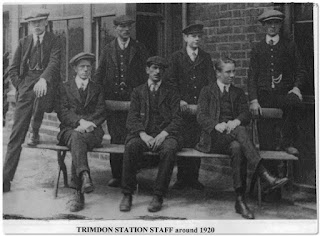
I wondered how Richard found himself living in Trimdon Station.  I know that in 1920 his step-mother Clara and her three young children, his half-siblings, moved to Iowa, USA, although I cannot be sure whether this coincided with his own move into lodgings at Trimdon Station or whether he had moved prior to their emigration.  The small town was still part of the colliery district servicing Trimdon Colliery, his fellow lodger was an above ground colliery worker, and the trains obviously formed a vital part of the industry.  I was lucky enough to find a really informative web-site Trimdon Times about the history of the three villages at Trimdon, apparently there was Trimdon Village, Trimdon Grange and then Trimdon Station.  Alongside all the written details are some amazing photographs.  I have spent more than a few half hours scrolling through them, hoping to spot Richard and, with the kind permission of Ken from Trimdon Times, am sharing a few below.


Pictures shared with the kind permission of Trimdon Times

The station photograph is dated after my Grandfather will have left however the staff photographs are contemporary
I half-think I can see some similarities between some of the young men and my Grandfather in the image below

Photograph of Richard Wright 1922/23
Own Collection

The next time I can find any official records for Richard is when he married my Grandma, Naomi in 1937, and whilst I would like to know more about his life in the interim period I have run out of ideas of where to look for the moment.  I do know that for a time he was not working for a railway company, as he is shown on the 1939 Registeras a Poultry Farmer and Special Constable, but he did return to work in the Goods department at Louth Railway Station, at some point, and I have been lucky enough to connect online with a few people who remember him from that time.  

Richard's Special Constable Anti-Gas Certificate
Own Collection

I know that due to his work being in a reserved occupation he had not served in the Armed Services in either of the World Wars, but I was surprised to learn recently (when researching for this blog post actually) that Louth Station was bombed in 19419, sadly killing an engine fireman who was shunting in the goods yard! I want to know, and yet I don’t at the same time, whether Richard was working that day, was he still a first aider, was he involved in trying to help? How well did he know the poor man, his widow and his 3 sons? Aged 42 the gentleman who died was just a year younger than Richard would have been; I can’t even imagine how that would have affected my grandparents, such a gentle and social couple, who whilst being aware of the difficulties of the conflict may have still felt distanced from it in our sleepy, rural neighbourhood.

Although the station closed for passengers the year I was born, 1970 and for goods/freight in 1980, we were lucky in that the beautiful neo-Jacobean station building (built in 1847 – designed by John Grey Weightman and Matthew Ellison Hadfield of Sheffield) 10, 11 remains, and now forms a focal part of a local housing development, and it still makes me think of my grandfather when I see it. 

Louth Railway Station Circa 1908 
Shared with kind permission of John Alsop

I think he would be especially proud to know that my son, his Great-grandson, Jacob, is now working on the railways himself, East Midlands Railway, and in less than a month is due to qualify as a senior conductor.  Maybe the apple doesn’t fall far from the tree after all!! 

(As I re-read that it brought a smile to my face remembering all the apple trees Richard had planted in our orchard – very apt!)


1.        Hedley, M 2021 Women of the Durham Coalfield in the 20th Century : Hannah’s Daughter Page 6,The History Press First Edition (Kindle)

2.        Archive: Modern Records Centre, Archive reference: MSS.127/NU/OR/2/44, Folio or page 266, Title General Register, Dates: Jun-Oct 1915, Information contained: Members 643001-658000, via Find My Past, accessed 02/02/2022

3.        John Wright (1918) Certified copy of death certificate for John Wright, 28th November 1918, No 337 Sunderland Register Office (Copy obtained via GRO.gov)

4.        Richard Wright (1921) Census return for Cooks Buildings, Trimdon Station, Easington, Wingate, Durham 552-1 30 Schedule 156 Line 3; Available at https://www.findmypast.co.uk/  (Accessed: 12/01/2022)

5.        Richard Wright (1901) Census return for Eppleton Row, Hetton-le-Hole, Houghton-le-Spring, Durham Public Record Office: RG13; Piece 4695, Folio: 106; Page: 12 Available at http://www.ancestry.co.uk/ (Accessed 15/06/2020)

6.        Richard Wright (1911) Census return for Fenwick Street, Sunderland West, Durham Public Record Office: RG14; Piece30145; Available at http://www.ancestry.co.uk/ (Accessed Reference 15/06/2020)

7.        Richard Wright (1909) National School Admission Registers & Logbooks 1870-1914, 1909 Admissions Bishopwearmouth Church of England School – Boys, Page 30 Admission No 9233; Available at https://www.findmypast.co.uk/  (Accessed: 12/01/2022) 

8.      Richard Wright (1939) England and Wales Register return for Louth Road, Cockerington, Louth, Lincolnshire, Part of Lindsey, The National Archives, Kew, London, Reference RG 101/6477A ; Available at http://www.ancestry.co.uk/ (Accessed 15/06/2020)

9.      (1941) Raider Swoops on Lincs. Market Town: Five Dead, Lincolnshire Echo 20th Feb 1941 Available at https://www.findmypast.co.uk/  (Accessed: 12/01/2022)

10.    Catford N (2009) Station Name: Louth Available at http://www.disused-stations.org.uk/l/louth/ (Accessed 10/01/2022)

11.    Wikipedia (2009) Louth Railway Station Available at https://en.wikipedia.org/wiki/Louth_railway_station (Accessed 10/01/2022)


Wednesday, 26 January 2022

2022 - 52 Ancestors in 52 Weeks - Weeks 3 and 4 (Incorporating #MyGenealogyStory)

 Week 3 (Jan. 18-24): Favorite Photo and Week 4 (Jan. 25-31): Curious - incorporating  #MyGenealogyStory 

When I first saw the final two week topics for January, I wasn’t completely sure what I was going to write about; did I even have a favourite photograph? But then I saw another prompt suggesting writing about #MyGenealogyStory on Twitter (courtesy of Daniel Loftus @DanielGenealogy) and after reading Paul Chiddicks blog post about how and why he got started (here) I decided to try and combine the three.

If you read my Week 2 post about finding a Family Bible, you will already have some insight into why I decided to begin to research my family tree.  For me it was all about being curious about who I was/am and where my roots where from (especially on my paternal side).


Cover of  the Family Bible
Writer's own

Having spent over three years from the age of 6 moving house copious times in a strange foreign country, the Communist Czechoslovakia, now the Czech Republic, having only limited contact with family back home, and then losing my dad at a young age (10), meant I felt a step apart from most of my family.  My dad was an only child of elderly parents, his father had died when I was 6 months old and my grandma didn’t really like to talk too much about that side of the family, saying only “there had been a second marriage” that made it difficult.  I now know that my Great-Grandmother had died when her children were very young and her husband, my Great-Grandfather remarried and had three more children, following his death his widow took her three children across to the US, but my paternal grandfather and his siblings remained in England.  Combined with the fact that Grandma's side of the family were a typical rural Lincolnshire family, with a “life happens just get on with it” point of view it meant that I didn’t really experience any sharing on family stories from my paternal line at all.  On my maternal side, I was at least blessed with a bit more knowledge of the family history, my maternal grandmother’s family were descended from residents of the Yorkshire village of Duggleby, (there is a family tree tracing that line back to the time of the Domesday book - here) but again there is less information about my maternal grandfather’s side of the family.  I have an uncle and aunt that I can ask questions of, and I was very lucky that my aunt recently passed me some paperwork, including a small address book that belonged to my maternal great-grandfather.  All that aside, I have found that there is still some inconsistency and mistruth, woven into the few stories I have been given.

Therefore the motto of the #Curious part to the #Foundations of my journey into my family history is, as I’m sure it is for many “Who am I and where do I come from?”

Royalty free image via depositphotos.com

I think my research into the family tree truly began not long after the break-up of my first marriage; sitting by myself once the children were settled, the question of ‘Who am I’ was quite large in my mind and so I tried to piece together what I could jotting down notes here and there and asking my mum, who was still with us at that time about her family and grandparents.  She made notes for me of what she could remember, notes which incidentally I’ve recently come across again, and it’s worth noting how family stories and what we think of as factual information can actually be incorrect.  My mum told me that her grandfather had been married twice (true), that his first wife had died (false) so he was free to remarry; this was important as they were from a strict Catholic background. I’ve since found that he actually divorced his first wife on the grounds of her adultery, which would perhaps explain his subsequent move to a new area with his second wife. I’m not convinced it would explain the 3 year reduction in his recorded age though, which was even carried through to his funeral notice, perhaps he just mis-remembered? That 3 year difference, combined with the fact his surname had been incorrectly spelt, Cairns instead of Kerrin, made finding his Glasgow birth record difficult, but I did manage to track it down eventually.  The fact that the Scottish records have additional information such as parents marriage made me certain I had got the correct record.


Bundle showing some of my mother's notes and the 2006 printouts of my previous research

Once my children had both started school, and with the advent of online records becoming more available I started researching with more earnest.  Alongside my mother’s notes mentioned above, I’ve also come across a lot of printed searches and small family tree entries I made in 2006.  Again, I can see the lessons I have learned since.  On some of my early forays into online research, I made the basic, but easy, mistake of taking a suggested tree at face value; if their details for the members I knew were correct tallied, I would often add the details for the extended family members. I know, I know, rookie error!! But we live and learn, and I have managed to tweak and correct the errors as I have come across them in my recent research foray which began when I turned 50. My current aim is to write up the lives and details of my grandparents and great-grandparents.  I decided that once and for all I wanted to produce the best researched family tree I could for my, now adult, children. They may not presently be that interested, but as I am the last person who can at least give some personal context to the family stories, I want to make sure that if they do develop an interest, they have something meaningful to refer to.

I’m returning to the prompt of Curious again here, as part of the next stage of my genealogy journey. My desire to bring meaningful, realistic and valid stories to my ancestors lives led me to join the wonderful Curious Descendants Club, the brain child of the equally wonderful NataliePithers. Within the club’s pages lie a vibrant, supportive forum of other family historians, and a whole range of workshops and challenges. There is a wealth of information amongst the members of the club, which includes people from across the globe, who are able to provide suggestions for locating records in areas we may not be used to. For example, until it was mentioned by one of the members, Jenny, I was unaware of Trove, an amazing body of Australian online papers, gazettes and magazines, and surprisingly it’s free.  I took a look, and have managed to use the site to locate funeral notices, court reports and some articles giving a small insight into some of the social life for an Australian great-uncle. The main focus of the club is to help us to hone our skills in writing about the various individuals on our family trees, and there is always someone to offer valuable feedback on a piece of writing.


Sample of records downloaded from Trove (https://trove.nla.gov.au/)

Due to a frustratingly long flare up of the costochondritis and intercostal neuralgia that I experience as part of my fibromyalgia, I have been experiencing, what even for me, is a prolonged period of inactivity over the last few weeks. However, my wonderful husband, who has been watching my renewed enjoyment of genealogy research, bought me a belated Christmas/early birthday present of a photograph scanner, he then brought down the boxes of old photographs that have been living in the attic for far too long, putting them in front of me with a smile.  Incidentally it was within these boxes that I also found mine and my mother’s notes referred to above.  He knew that this would help me take the next step in reaching the level of research I need to in order to produce a comprehensive family record.

Some of the photos brought down from the attic

As I began working through them it was incredibly hard to work out who a lot of the people were and which side of the family they belonged to, I had for the most part kept any from my maternal and paternal sides separate but there were some that had slipped into the wrong pile. Cue many distracting moments trying to expand on faces without making them too blurry and flicking between one photo and the next to see if I could recognise any similarities! I believe that I have now correctly ordered them into the right family groups, but I still have many more to scan.  

Whilst going through this process I was also trying to see if I could decide on what would be my favourite photograph for the purpose of the #52Ancestorsin52Weeks prompt.  I lost count of how many times I changed my mind!!  

Would it be the one of my dad in his early RAF days when he took part on an inland waterways canoeing challenge with some colleagues?  


Newspaper clipping from Yorkshire Post and Photograph showing my Dad stepping into his canoe (1962)
From Writer's Private Collection

A beautiful photograph of a young lady dated approximately 1910-15 which I believe to be my paternal Grandma?

From Writer's Private Collection

Or even a delightful photograph of a young boy (a 1st cousin 2x removed) sitting in a pedal car in 1920s America?  

"Cyril in Omaha"
From Writer's Private Collection

Decisions decisions!! In the end the photo(s) I’ve chosen to be my favourite, are a completely unexpected choice.  Amongst all the photographs were several wedding pictures of couples where I had no idea who I was looking at. One of these though was embossed with the details of the photography studio which was located in Sunderland, and there was another, old picture of a young girl also marked with a (different) Sunderland photographic studio.  I knew that my paternal grandfather was from Sunderland, but didn’t have any information about his siblings also from that area.  I decided, although I knew it was a long shot, to put those photos on the Sunderland Antiquarian Facebook page, in the hope that someone might recognise the people in the pictures.  

Three photos shared on Facebook
From Writer's Private Collection

Amazingly, just two days later I was in touch with Jen, the daughter of the young girl in the photo who was also the bride in the other photos.  Jen explained that her maternal grandmother was the sister of my grandfather, my great aunt Sarah, making Jen my 2nd cousin!! So far we have exchanged brief information, and I’m hoping that at some point over the next year I can meet her and her brothers face to face.  Jen, sent me copies of two photos, one of which shows our great-grandparents and their 5 children, it’s just amazing, and has totally stolen the title of my favourite photograph!!

Photograph showing L-R William, Sarah (Jen's Grandma), Eveline, John (my Gt-Grandfather), Ann, Mary (my Gr-Grandmother) and Richard (my Grandfather)
Private Collection - shared with Jen's kind permission.

So, where am I now? Where has my curiosity brought my genealogy story?  My initial careless meanderings through family history is evolving into more thorough genealogical research, into which I am beginning to incorporate real context using additional record sources. I have a new-found favourite photograph together with some newly found relations; and I have a proper goal of what it is I am wanting to create, and why.

I am excited to see where my journey takes me next!!